
Wichita County Probate Division
Probate in Wichita County is part of the District Court. Kansas district courts handle probate and administration of estates, guardianships, conservatorships, care and treatment matters, and related filings. The local court is Wichita County District Court at 206 S 4th Street, Leoti, KS 67861, with the district clerk available at 620-260-2560. The research did not locate a separate Wichita County probate court, separate probate clerk, or county-run probate search site.
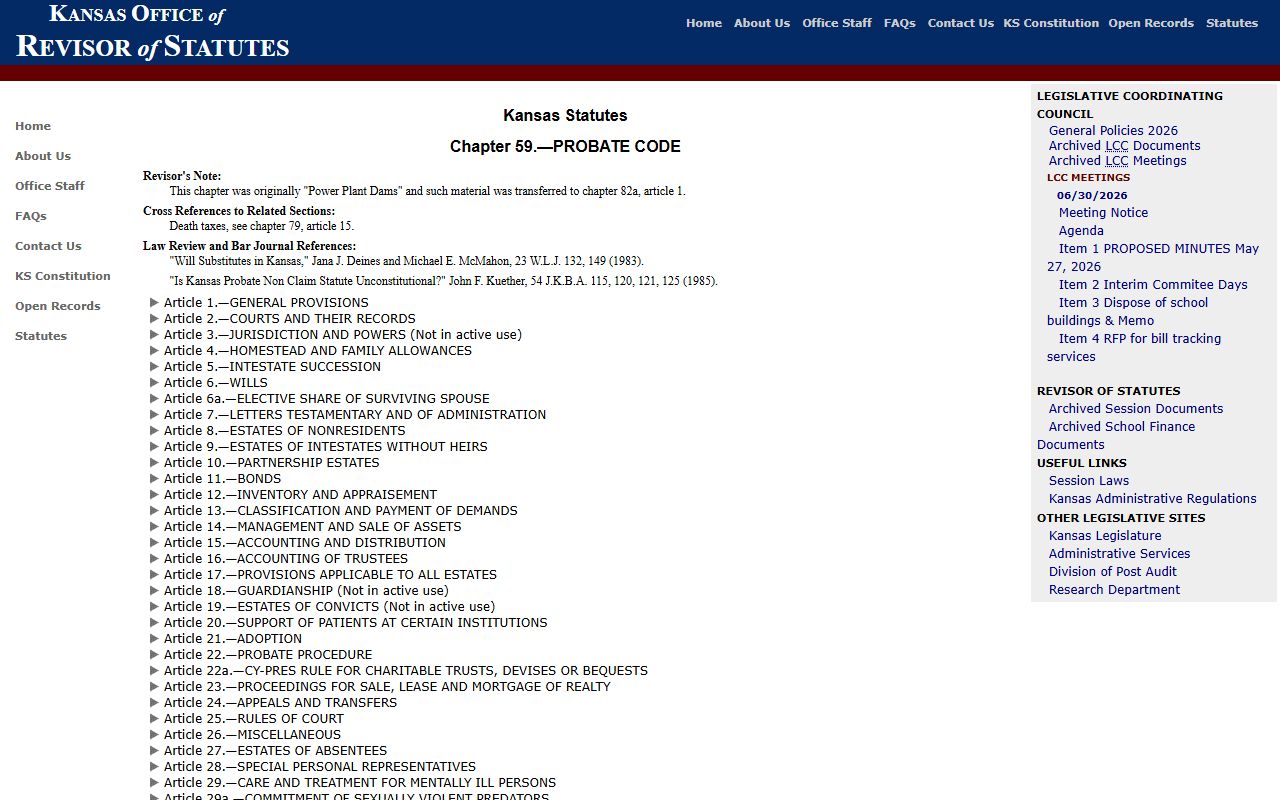
The Kansas probate framework is collected in the Kansas Probate Code index, which includes estate provisions, small-estate law, adoption restrictions, and related probate topics.
Probate Division of the District Court
Wichita County District Court
206 S 4th Street
P.O. Box 968
Leoti, KS 67861
620-260-2560
Fax: 620-375-2999
Monday-Friday, 8 a.m.-noon and 1 p.m.-5 p.m.
Wichita County Probate File Types
A Wichita County probate record may be a simple estate filing or a long case file with petitions, orders, inventories, notices, claims, and accountings. Some matters begin after death. Others involve living persons, such as guardianship and conservatorship cases. Because access can differ by record type, the first practical question is whether the request seeks a public estate document, a certified order, a restricted guardianship file, or a small-estate affidavit that may not have opened a full case.
- Wills filed for probate and petitions for probate or administration.
- Orders admitting a will and letters testamentary or letters of administration.
- Inventory and valuation filings, creditor notices, claims, and publication proofs.
- Sale orders for real estate or personal property and final settlement papers.
- Guardianship and conservatorship petitions, evaluations, inventories, annual reports, and accountings.
- Minor's estate guardianship records and trust-related petitions when filed with the court.
Probate records can overlap with land records, vital records, and civil court records. A deed transfer may be recorded by the County Clerk / Register of Deeds after a probate order, while the order itself remains a court record. Certified death, marriage, or divorce certificates are not issued by the probate clerk.
Wichita County Probate Terms
Probate files use short legal terms that are easy to confuse. These definitions are plain-language labels for reading a Wichita County probate docket or order. The formal legal effect depends on the filing, statute, and judge's order.
- Testator
- A person who made a will.
- Executor
- A person named in a will to carry out estate duties after court authority is granted.
- Administrator
- A person appointed to manage an estate when there is no will or no executor able to serve.
- Intestate
- Dying without a valid will, so distribution follows Kansas intestacy law.
- Guardianship
- A case asking the court to appoint someone to make personal-care decisions for a minor or adult.
- Conservatorship
- A case asking the court to appoint someone to manage money or property for another person.
Search Wichita County Probate Records
Public probate case data may be searchable through Kansas Case Search when available under Kansas Supreme Court Rule 22. The statewide portal is the correct online starting point because Wichita County does not publish a separate probate database. If the portal does not show a needed filing, the record may still be available at the courthouse terminal or by request to the Clerk of the District Court.
- Start with Kansas Case Search and use the decedent name, party name, business name, or case number if known.
- Confirm the result is Wichita County, Kansas or the 25th Judicial District, not Wichita city or Wichita County, Texas.
- Review case-level data first, including case number, file date, party roles, case status, and event entries.
- For document images, certified copies, older probate files, or missing online records, call the Clerk of the District Court.
- Use mail or fax only after confirming the copy fee, certification need, delivery method, and payment instructions.
Rule 22 access can change by case type. The research notes 2025 updates that made certain domestic, juvenile offender, and probate categories available through the public portal, but sealed and restricted records remain outside public access.
Wichita County Small Estates
A Kansas small-estate affidavit can be a probate alternative for eligible personal property. It is not the same as a full probate estate administration. Under K.S.A. 59-1507b, an affidavit process may be used for certain transfers without letters testamentary or letters of administration when statutory conditions are met.
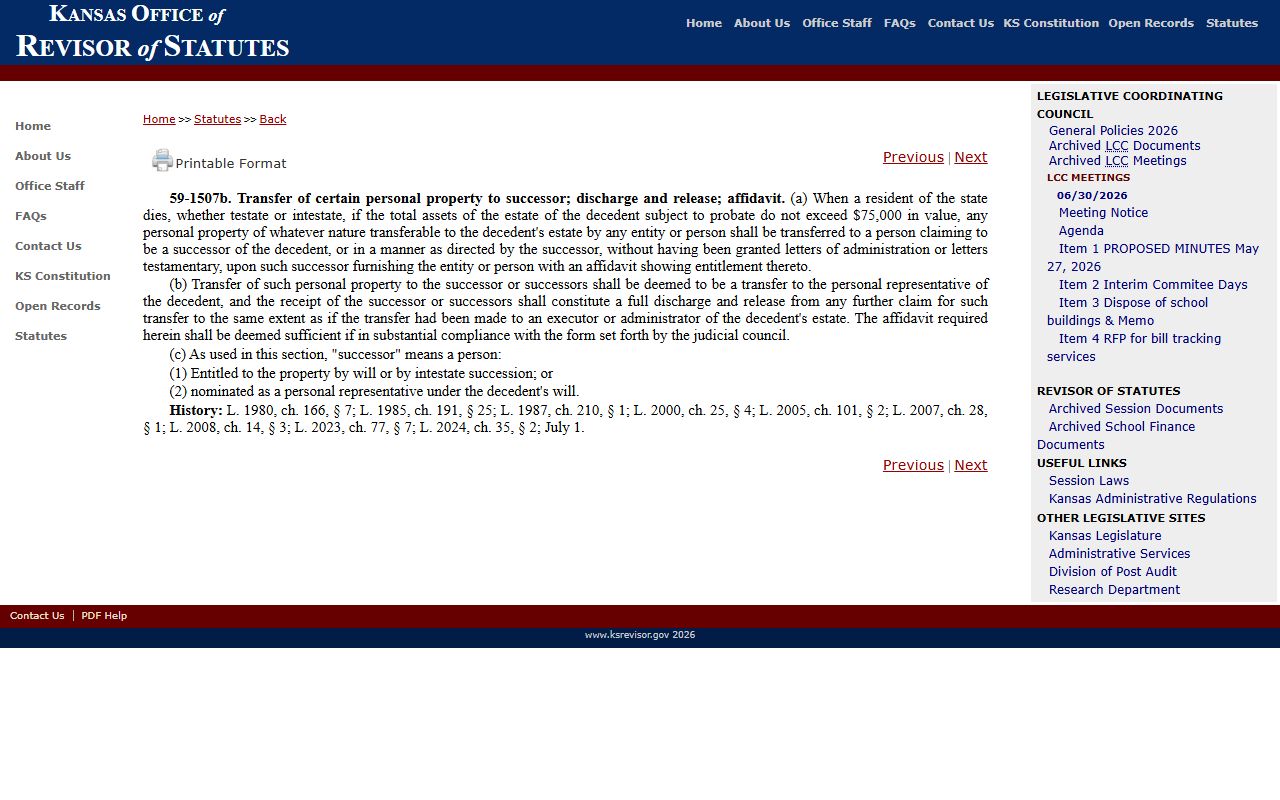
The Kansas Judicial Council small-estates affidavit page says its forms are free for non-commercial use and cannot be sold or republished for compensation. The KDOR TR-83b small estate affidavit PDF also references K.S.A. 59-1507b and identifies the form as tied to estates under $75,000. Vehicle transfers may require vehicle-specific fields even when the broader estate issue is probate-related.
| Field | Required | Notes |
|---|---|---|
| Decedent name | Yes | Identifies the person who died. |
| Date of death | Yes | Needed to establish estate facts. |
| Beneficiaries or heirs | Yes | Names, ages, relationships, and addresses may be requested. |
| Personal property description | Yes | Can include insurance proceeds payable to the estate. |
| Property value | Yes | The current form references estates under $75,000. |
| Vehicle information | Conditional | Year, make, style, VIN, and value may be needed. |
| Affiant signature | Yes | The person making the statement signs. |
| Notary block | Yes | Includes notary stamp, signature, date, and commission details. |
Wichita County Probate Fees
The research did not locate an official Wichita County probate filing fee schedule or local certified-copy amount. That gap matters because probate filings can carry different costs than ordinary copies, and some requests need certified letters or certified orders. Before mailing any payment, call the Clerk of the District Court and ask for the current filing fee, copy cost, certification cost, payment method, and whether a self-addressed return envelope is needed.
| Item | Amount | Source note |
|---|---|---|
| Probate filing fee | Not located in official Wichita County sources | Confirm with the district clerk. |
| Certified copies of letters or orders | Not located in official Wichita County sources | Confirm fee and certification process before requesting. |
| Plain probate copies | Not located in official Wichita County sources | Ask whether page charges apply. |
| Small Estates Affidavit form | Free form from Kansas Judicial Council / KDOR source | Notary, title-transfer, or other non-court fees may apply. |
Note: A missing local fee schedule is not a free-service statement. It means the fee should be confirmed with the clerk before filing or ordering copies.
Restricted Wichita County Probate Records
Not every probate-related file is public. Adoption files are restricted under Kansas probate and adoption statutes. Some guardianship, conservatorship, mental health, care-and-treatment, minor, medical, and sealed filings can also be limited. Rule 24 and related court policies protect personally identifying information such as Social Security numbers, financial account numbers, birth dates, addresses, and minor identifiers.
When a Wichita County probate record does not appear online, the reason may be practical or legal. It may be older, not scanned, available only at the courthouse, sealed, restricted, or missing from public portal access. The district clerk can identify request logistics, but the clerk cannot give legal advice about whether a person is entitled to a restricted file. Parties, heirs, guardians, conservators, attorneys, and interested persons may have different access rights.
For family-history or estate-settlement work, ask for the exact document needed. Letters testamentary, an order admitting will, a final settlement order, or a certified guardianship order are not interchangeable. A focused request helps the clerk locate the case and quote the right fee.