
Wichita County Arrest Records and Court Charges
An arrest record is created on the law-enforcement side. It may identify the person arrested, arresting agency, date, booking or custody status, alleged reason for arrest, warrant or probable cause basis, and release information if the sheriff keeps and releases those details. In Wichita County, the local law-enforcement contact is the Wichita County Sheriff's Office at 411 South 4th Street in Leoti, phone 620-375-2723. No official county online jail roster or booking database was located in the research.
A court charge record is different. It starts when the county attorney or prosecutor files formal charges in court. Once filed, charges become part of the district court case record, subject to public-access rules, sealing, juvenile limits, and redaction rules. For custody and jail questions, use the local sheriff or the Wichita County inmate records route. For the full case file, plea, disposition, and sentencing, use criminal court records.
The KBI media releases source is a statewide law-enforcement news source, not a Wichita County arrest database.
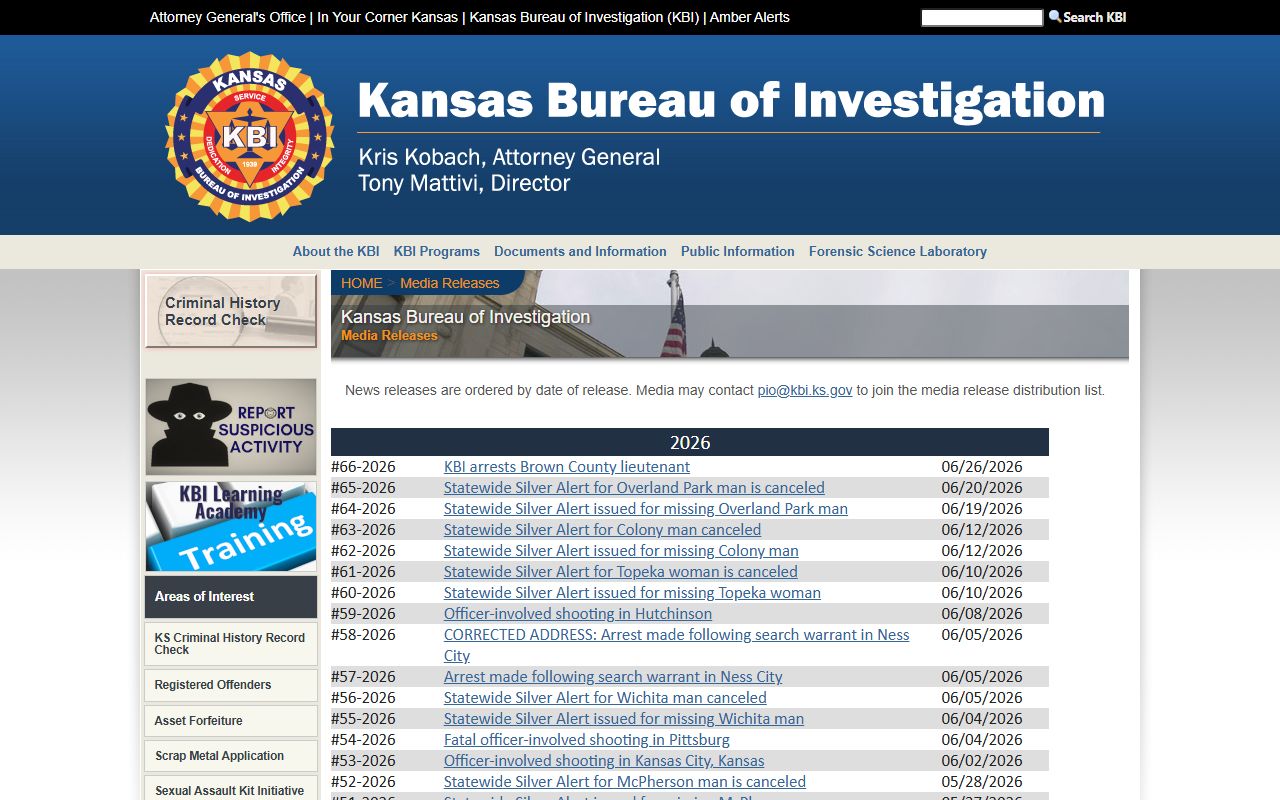
Use official agency and court sources for records. News releases do not replace sheriff records or filed court charges.
Find Wichita County Arrest Records and Charges
There is no official Wichita County, Kansas online arrest list or jail roster in the located sources. For a recent arrest, call the Wichita County Sheriff's Office and ask whether the person is in custody, released, transferred, or booked under a different name. For filed charges, use Kansas Case Search or call the Clerk of the District Court. The court side may lag behind the arrest side until the prosecutor files a case.
- For custody or booking status, call the Wichita County Sheriff's Office at 620-375-2723.
- For filed charges, search Kansas Case Search by defendant name or case number.
- Confirm the case is Wichita County District Court in the 25th Judicial District.
- Open the case and read each charge description, statute, severity level, and status.
- Call the Clerk of the District Court at 620-260-2560 for public documents that are not online.
- Use KBI criminal history only when a statewide fee-based background search is needed.
The KBI/Kansas.gov criminal history search is not a local arrest log and not the full Wichita County court file. It is a statewide background-search channel. The court charge record remains the better source for the case-specific accusation, docket, and outcome.
Charges After Arrest Documents
Charges after arrest become formal when a charging document is filed. Kansas district court criminal files may include a complaint or information. An indictment is possible in some criminal systems, but ordinary local prosecutions are usually handled by complaint or prosecutor-filed information. The exact document name matters less than the fact that the filed charge is an accusation, not a conviction.
| Document | Who Files It | What It Usually Shows | Why It Matters |
|---|---|---|---|
| Complaint | Officer or prosecutor, depending on the case | Alleged offense, date, statute, defendant, and probable cause basis | Often starts the criminal case or supports first appearance. |
| Information | Prosecutor | Formal charge list, statutes, severity levels, and counts | Common prosecutor-filed charging document in district court. |
| Indictment | Grand jury | Grand-jury accusation and count list | Less common locally, but still a charging document type. |
One arrest can produce no filed case, one charge, or several counts. A charge can also be amended, reduced, dismissed, or replaced as the prosecutor reviews facts, criminal history, witness issues, diversion eligibility, and plea negotiations.
Wichita County Charge Status Table
Charge status tells the reader where each accusation stands. The status can change while the case is pending. A pending felony charge is not the same as a conviction. A dismissed count may remain visible in the case history unless sealed or expunged. A diversion can show that the defendant entered a prosecutor-controlled alternative process, but the record effect depends on the agreement and later court orders.
| Status | What It Means | What To Check Next |
|---|---|---|
| Filed / Pending | The accusation has been filed and has not reached final outcome. | Next hearing, bond, motions, and deadline entries. |
| Amended | The charge wording, count, statute, or severity may have changed. | Compare the original charge with the latest filing. |
| Reduced | The prosecution or plea process changed the charge to a lesser offense. | Look for plea and disposition entries. |
| Dismissed | The court or prosecutor ended that charge without conviction on that count. | Check whether dismissal was with or without prejudice if shown. |
| Diversion | The prosecutor allowed an alternative agreement for eligible cases. | Confirm completion terms and any later expungement or dismissal entry. |
| Convicted | The charge ended in a guilty finding or qualifying plea. | Read sentencing, probation, fines, restitution, and postrelease entries. |
Charges vs Convictions
A Wichita County court charge record can list accusations that never became convictions. This is the most important reading rule for charges after arrest. A person may be arrested, charged, and later have a count dismissed. A plea may resolve only some counts. A trial may lead to acquittal on one charge and conviction on another. Read the disposition line before treating a charge as a final result.
| Point | Charge | Conviction |
|---|---|---|
| Legal Meaning | Formal accusation filed after arrest or citation | Final guilty result by plea, verdict, or qualifying finding |
| Where It Appears | Complaint, information, docket, bond, and hearing entries | Disposition, judgment, sentencing, and payment entries |
| Can It Change? | Yes, it may be amended, reduced, dropped, or dismissed | It may be appealed, corrected, or expunged if eligible |
| Search Risk | Easy to mistake for guilt | Still needs context, sentence, and later orders |
Sheriff Records vs Court Charges
The sheriff and the court keep different records. The sheriff handles arrest, custody, booking, service of warrants, and law-enforcement records. The court handles filed charges, docket events, hearings, orders, plea, disposition, and sentencing. A sheriff arrest record may exist before a court case appears. A court case may continue after the person is no longer in jail.
| Question | Sheriff Side | Court Side |
|---|---|---|
| Is the person in custody? | Call Wichita County Sheriff's Office. | Court docket may not show current housing. |
| What charge was filed? | Arrest reason may be preliminary. | Filed complaint or information controls the court charge. |
| Was bond set? | Sheriff may know current release logistics. | Court record may show bond order or changes. |
| What was the outcome? | Not the primary custodian. | Disposition and sentencing are court records. |
The CitePayUSA source is relevant when a charge or citation becomes payable through the 25th Judicial District ticket-payment route.
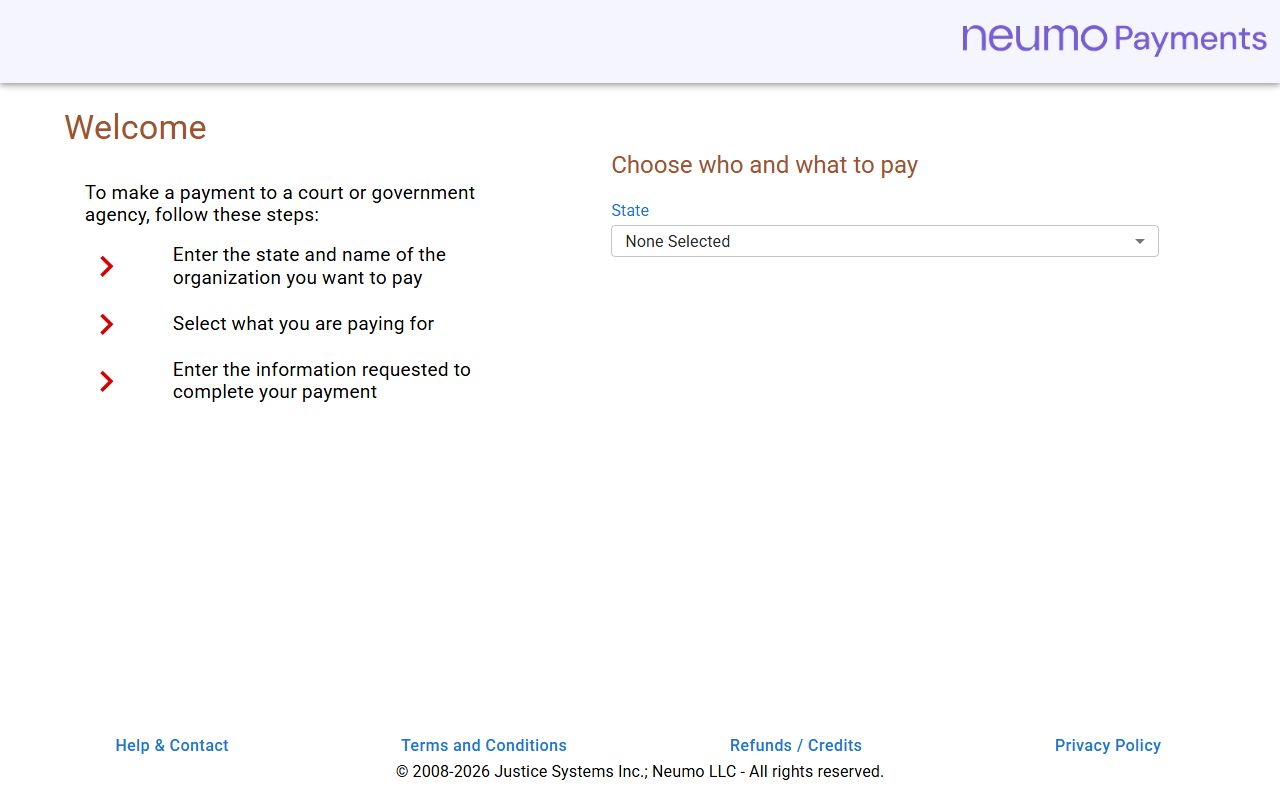
Paying a citation can have legal effects, so confirm the court and charge before using a payment portal.
County Attorney and Diversion
Wichita County uses a County Attorney. The 25th Judicial District diversion page lists County Attorney Laura Lewis at 620-375-2915. The county attorney is the local prosecutor contact found in official research for many criminal charges, diversion decisions, and traffic or criminal prosecutions. The prosecutor decides what charges to file, whether to amend or dismiss counts, and whether diversion is available for a specific case.
Diversion is not the same as a conviction, and it is not automatic expungement. It is a prosecutor-controlled alternative route for some eligible matters. If the person completes diversion, the docket may later show dismissal or other closure depending on the agreement. If diversion is not completed, prosecution may continue. Defendants should ask defense counsel or the court about how diversion affects the public record.
Sealed and Expunged Charge Records
Kansas law allows eligible expungement of certain convictions, arrest records, and diversion agreements under K.S.A. 21-6614. The statute includes waiting periods, exclusions, filing requirements, and court review. A person generally petitions the court that handled the conviction, arrest record, or diversion. For Wichita County filing logistics, start with the Clerk of the District Court.
| Point | Sealed | Expunged |
|---|---|---|
| Public Access | Hidden from public view by order, rule, or statute | Limited after an eligible petition and court order |
| Applies To | Cases, documents, or sensitive entries | Eligible convictions, arrest records, or diversion agreements |
| Portal Effect | Not available through public search or terminal access | Public visibility depends on the order and statute |
| Limits | Authorized users may still have access | Some law enforcement, licensing, or statutory access can remain |
The Kansas expungement statute source supports the charge-record restriction and clean-up discussion for Wichita County arrest records.
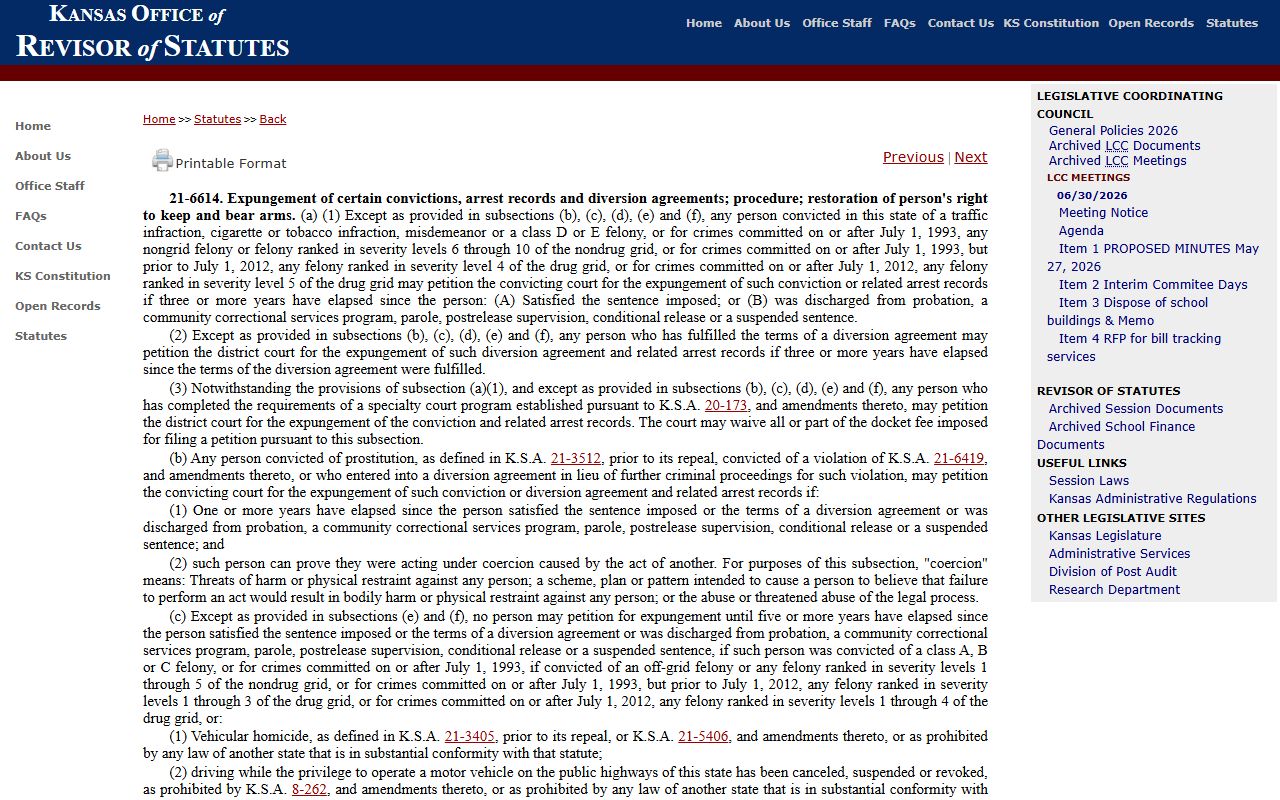
Do not assume a dismissed or old charge has disappeared from every agency record without a court order.
Restricted Wichita County Charge Records
Juvenile charges, sealed cases, expunged records, victim-protection details, mental health records, and personally identifying information may be restricted or redacted. Kansas Chapter 38 treats juvenile court and law-enforcement records differently from adult public files. Kansas Supreme Court Rule 24 protects personal identifiers in filings. Search warrants and active investigative materials may also be withheld.
If a charge is missing from a public search, check the court, county, spelling, and date first. Then ask the clerk whether it is not filed, not public online, available only at the courthouse terminal, sealed, expunged, juvenile, or tied to a municipal court. For arrest-only information that never became a filed court charge, the sheriff is the better starting point.